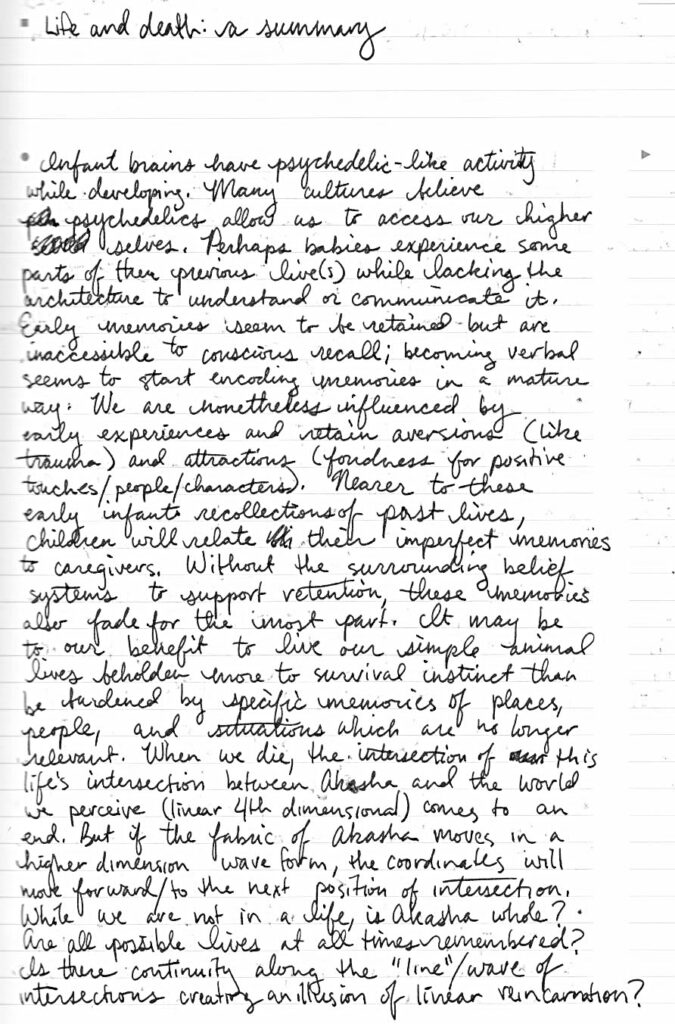
Infant brains have psychedelic-like activity while developing. Many cultures believe psychedelics allow us to access our higher selves. Perhaps babies experience some parts of their previous live(s) while lacking the architecture to understand or communicate it. Early memories seem to be retained but are inaccessible to conscious recall; becoming verbal seems to start encoding memories in a mature way. We are nonetheless influenced by early experiences and retain aversions (like trauma) and attractions (fondness for characters/positive touch/people). Nearer to these early infant recollections of past lives, children will relate their imperfect memories to caregivers. Without the surrounding belief systems to support retention, these memories also fade for the most part. It may be to our benefit to live our simple animal lives beholden more to survival instinct than be burdened by specific memories of people, places, and situations which are no longer relevant. When we die, our current intersection between Akasha and the world we perceive (linear 4th dimensional) comes to an end. But if the fabric of Akasha moves in a higher dimension wave form, the coordinates will progress to the next position of intersection. While we are not in this life, are we unified with Akasha? Are all possible lives at all times remembered? Is there continuity along the “line”/wave of intersections creating an illusion of linear reincarnation?