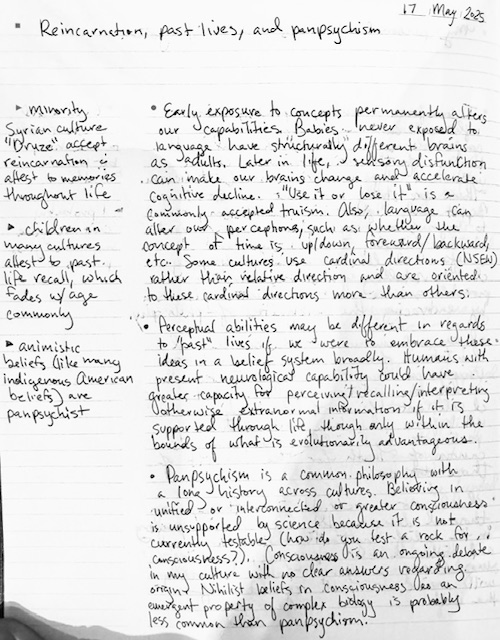
Early exposure permanently alters our capabilities. Babies never exposed to language have structurally different brains as adults. Later in life, sensory disfunction can make changes in our brains that accelerate cognitive decline. “Use it or lose it” is a commonly accepted truism. Also, language can alter our perceptions, such as whether the concept of time is up/down, forward/backward, etc. Some cultures use cardinal directions (NESW) rather than relative direction and are better oriented to absolute direction than others.
Perceptual abilities may be different in regards to “past” lives if we were to broadly embrace these ideas in a belief system. Humans with present neurological capability could have greater capacity for perceiving/recalling/interpreting otherwise extranormal information if it is supported through life, though only within the bounds of what is evolutionarily advantageous.
Panpsychism is a common philosophy with a long history across cultures. Believing in unified, interconnected, or greater consciousness is unsupported by science because it is not currently testable (how do you test a rock for consciousness?). The origin of individual consciousness is an ongoing debate in my culture with no clear answers regarding origin. Nihilist beliefs in consciousness as an emergent property of complex individual biology is probably less common than panpsychism.
- Minority Syrian culture “Druze” accept reincarnation and attest to these memories enduring throughout life.
- Children in many cultures attest to past life recall, which commonly fades with age.
- Animistic beliefs (common to indigenous peoples) are panpsychist