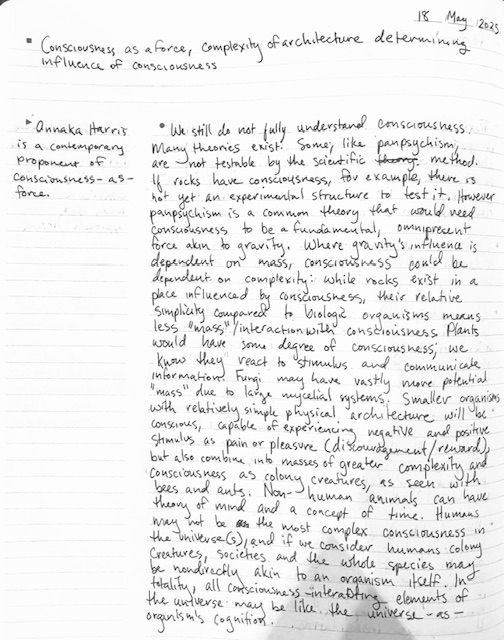
We still do not fully understand consciousness. Many theories exist. Some, like panpsychism, are not testable by the scientific method. If rocks have consciousness, for example, there is not yet an experimental structure to test it. However, panpsychism is a common theory that would need consciousness to be a fundamental, omnipresent force akin to gravity. Where gravity’s influence is dependent on mass, consciousness-as-force could be dependent on complexity: while rocks exist in a place influenced by consciousness, their relative simplicity compared to biologic organisms means less “mass”/interaction with consciousness.
Plants would have some degree of consciousness; we know they react to stimulus and communicate information. Fungi may have vastly more potential “mass” due to large mycelial systems. Smaller organisms with relatively simple physical architecture will be conscious, capable of experiencing negative and positive stimulus as pain or pleasure (discouragement/reward), but also combine into masses of greater complexity and consciousness as colony creatures, as seen with bees and ants.
Non-human animals can have theory of mind and a concept of time. Humans may not be the most complex consciousness in the universe(s), and if we consider humans colony creatures, societies and the whole species may be nondirectly akin to an organism itself. In totality, all consciousness-interacting elements of the universe may be like the universe-as-organism’s cognition.
- Annaka Harris is a contemporary proponent of consciousness-as-force.