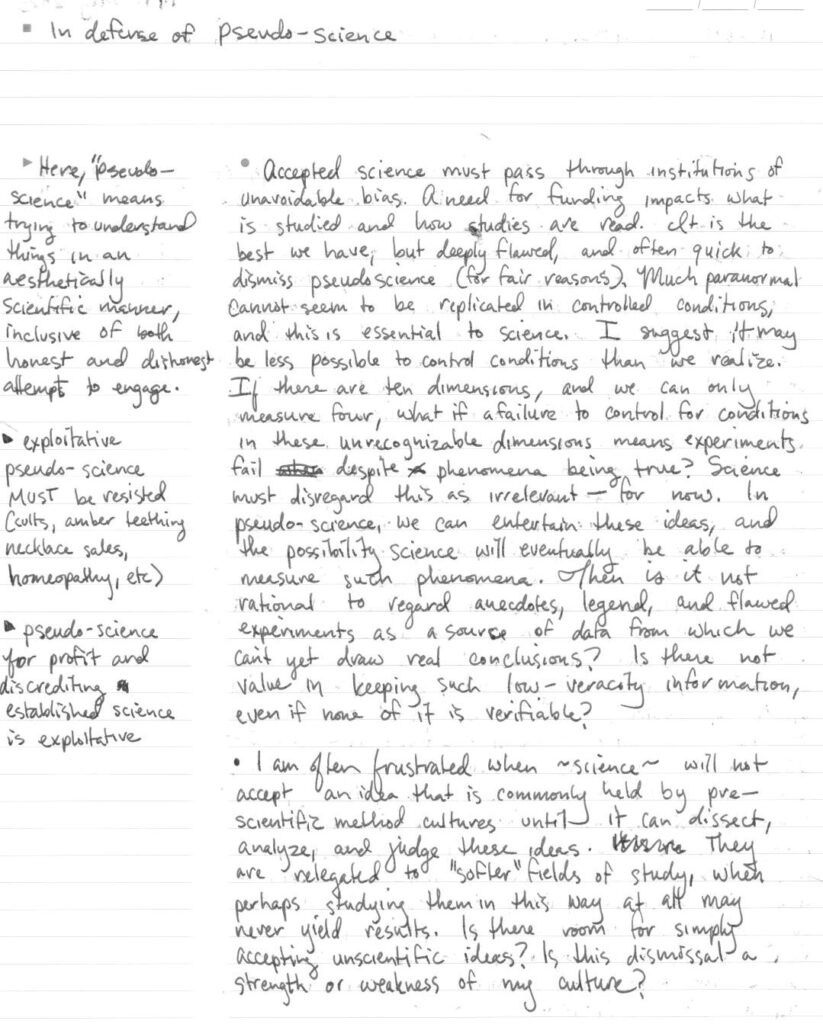
Accepted science must pass through institutions of unavoidable bias. A need for funding impacts what is studied and how studies are read. It is the best we have, but deeply flawed, and often quick to dismiss pseudoscience (for fair reasons). Much paranormal cannot seem to be replicated in controlled conditions, which is essential to science. I suggest it may be less possible to control conditions than we realize. If there are ten dimensions, and we can only measure four, what if a failure to control for conditions in these unrecognizable dimensions mean experiments fail despite phenomena being true? Science must disregard this as irrelevant–for now. In pseudoscience, we can entertain these ideas, and the possibility science will eventually be able to measure such phenomena. Then is it not rational to regard anecdotes, legend, and flawed experiments as a source of information from which we can’t yet draw real conclusions? Is there not value in keeping such low-veracity information, even if none of it is verifiable?
I am often frustrated when science will not accept an idea that is commonly held by pre-scientific method cultures until it can dissect, analyze, and judge these ideas. They are relegated to “softer” fields of study, when perhaps studying them in this way at all may never yield results. Is there room for simply accepting unscientific ideas? Is this dismissal a strength or weakness of my culture?
- Here, “pseudoscience” means trying to understand things in an aesthetically scientific manner, inclusive of both honest and dishonest attempts to engage.
- Exploitative pseudoscience MUST be resisted (cults, amber teething necklace sales, homeopathy, etc).
- Pseudoscience for profit and discrediting established science is exploitative.